
What Is YMYL and What It’s Impact on Healthcare SEO
Posted on
Behind the façade of any medical website, a battle for trust rages. Moreover, the stakes are really high here—people’s health. A patient searching for symptoms is trusting Google at one of the most vulnerable moments of their lives. The search giant’s response to this responsibility is the concept of YMYL (Your Money or Your Life). More than a technical term, it’s a philosophical principle that elevates user safety from aspirational to an absolute imperative and underpins modern healthcare SEO.
What Is YMYL? Why Does It Matter?
The term YMYL stands for “Your Money or Your Life.” It refers to any content that could significantly impact a person’s health, financial stability, emotional well-being, or overall safety. Healthcare is undoubtedly central. Symptom checkers, treatment explanations, and health insurance information all fall squarely within the definition of YMYL. After all, people make important health decisions based on what they read online.
What Is the Impact of YMYL Content on Healthcare SEO?
Google takes YMYL content very seriously. The search engine requires you to meet stricter criteria for such topics. Let’s imagine a user wants to find an answer to the question “What to do when you have a stomachache?”
If they land on a low-quality page with poor dietary advice and recommendations, they could seriously harm their health. Moreover, a reputable medical source will definitely advise a person to consult a doctor and get a diagnosis. And the dangers of self-medication should be emphasized.
It’s obvious that bad advice can harm a person’s health. Doctors are responsible for the information they provide to their patients in their offices, but they must also be responsible for the information they provide online, such as in blog articles. YMYL pages have the potential to cause harm, so Google holds them to a higher standard.
People who manually evaluate content based on Google’s experience, expertise, authority, and trustworthiness (E-E-A-T) standards review YMYL pages with even greater scrutiny.
How Google Evaluates YMYL Healthcare Content
A patient searching Google for information about their condition faces uncertainty and, often, anxiety. How can they distinguish a reputable medical resource from a site offering dangerous advice? Google’s YMYL system was created precisely for this purpose. It’s an internal filter that filters out content that doesn’t meet strict criteria for expertise and credibility in vital topics. For any clinic or medical publication, understanding and implementing YMYL principles becomes the foundation for building lasting trust with its audience.

Key E-E-A-T Factors Healthcare Websites Must Prioritize
For medical websites, E-E-A-T is a mandatory quality standard from Google. Your content must demonstrate expertise, experience, authority, and trustworthiness.
- Expertise: Clearly identify physician authors with their names, positions, and qualifications. Include the “Doctor Verified” label.
- Experience: Use patient stories, case studies, and answer fundamental questions, demonstrating a practical understanding of the issue.
- Authority: Obtain links to your website from reputable sources (e.g., universities, medical associations). Create thematic content clusters.
- Trustworthiness: This is key. Cite authoritative sources (PubMed, WHO). Contact information, a privacy policy, article update dates, and a medical disclaimer are required.
Create a digital resource that both patients and search engines will trust.
Best Practices to Improve Healthcare SEO Under YMYL Restrictions
1. Strengthen Content Credibility
Accuracy and depth of coverage are mandatory standards. The information directly influences users’ health and well-being decisions. Carefully verify every fact, figure, and statement with the source. Create a comprehensive and reliable resource that meets the highest E-E-A-T criteria and satisfies user needs and search engine requirements for YMYL.
2. Use Expert Medical Review Processes
Engaging experts is critical for YMYL content. This directly builds trust and meets E-E-A-T criteria. Find authoritative experts in your field through LinkedIn or professional associations. Feel free to offer collaboration. Many experts are interested in delivering accurate information to their audience. After planning the article topic, conduct personal interviews with experts (30-45 minutes) to gain unique insights and details.
Have an expert check and confirm the accuracy of the written content. This ensures trustworthiness. Include the “Reviewed by” tag directly in the article. Ideally, make it clickable to reveal detailed information about the reviewer, including their name, position, and qualifications. This ensures transparency for Google and users.
3. Build Authoritative Healthcare Backlinks
Backlinks are one of the most important authority signals for Google, especially for YMYL content. They demonstrate that your content is trusted as a valuable source. The strategy is built on two approaches. The organic approach involves creating unique, expert content that naturally attracts links. This is the most reliable method. The proactive approach is ideal for speeding up the process. You can use tools like the SEMrush Link Building Tool. For YMYL topics, links from authoritative sources (medical institutions, professional associations, educational resources) are critical. And remember that the quality and relevance of links are more important than their quantity.
4. Use Credible Sources
Cite only authoritative sources in YMYL content. This is a mandatory requirement for building trust and proving the veracity of information. Adhere to ethical standards and strengthen your reputation among readers and search engines. Proper citation directly demonstrates the trustworthiness criterion of the E-E-A-T framework. When you cite clinical studies, regulatory data, or the opinions of recognized experts, you demonstrate that your claims are verifiable and based on facts, not personal opinion.
How the Harm Principle Is Changing the Approach to Medical SEO
Initially, YMYL seemed like a simple list of “sensitive” topics: medicine, finance, and law. However, Google’s current approach, especially in healthcare SEO, is much more nuanced. The underlying principle is now harm-based evaluation. This approach fundamentally changes the paradigm of medical SEO. The term “YMYL” originated in Google’s Quality Raters Guidelines as a way to identify content with significant potential to impact users’ lives.

This means that algorithms ask not “What is this page about?” but “Can inaccurate information here cause real harm to health or well-being?” This approach requires content creators not only to be knowledgeable about the topic but also to take responsibility and implement quality control systems. This is why YMYL SEO shifts the focus from technical parameters to demonstrating to everybody expertise, authority, and trustworthiness. A successful healthcare SEO strategy today is, first and foremost, a strategy for building digital trust.
Medical Content: Multi-tiered Protection System
In healthcare, this principle is implemented through risk grading. A publication on the benefits of morning exercise and an article on a chemotherapy protocol are both YMYL-related, but they require significantly different levels of expert oversight. The evolution of YMYL takes this difference into account:
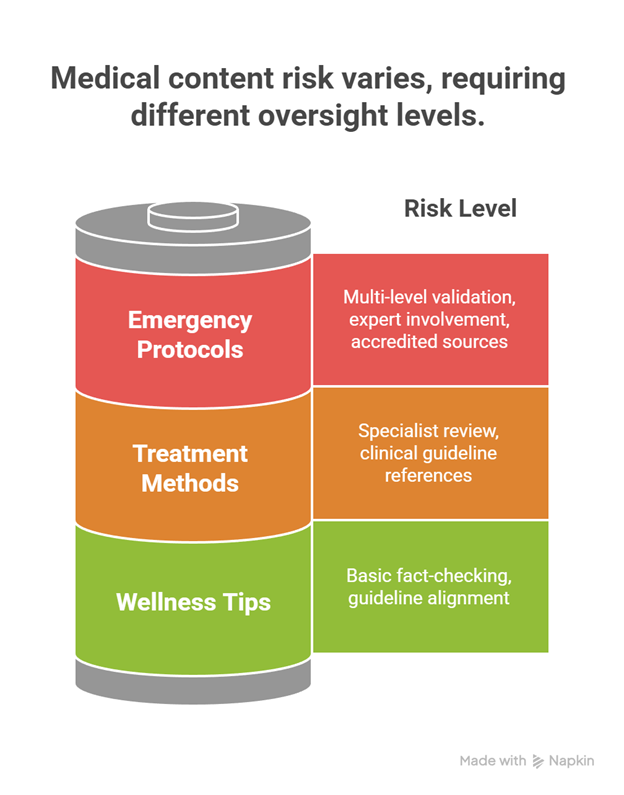
This principle of “harm” explains why even aggressive technical SEO optimization won’t help a website without deep expertise to rank for complex medical queries. Algorithm updates like the “Medic Update” were aimed precisely at this—promoting resources with proven expertise and demoting those that demonstrate superficiality or inaccuracy in critical areas.
YMYL in the B2B Healthcare Sector
An important nuance for modern healthcare organizations is that YMYL extends beyond patient-facing content. Google is consistently expanding this concept to include the B2B sector. This means that resources that should become part of the credible healthcare website ecosystem are also under increased scrutiny:
1. Medical technology websites: Descriptions of platforms for diagnostics, clinical data management (EHR), or telemedicine.
2. Specialist marketing: Content promoting physician training, high-tech equipment, or pharmaceutical products.
3. Resources on treatment methods: Information intended for medical institutions about new therapeutic approaches.

Why is this important? Because the decisions professionals make based on this information ultimately affect patients’ lives. Therefore, to ensure your B2B resource is perceived as a credible source, demonstrating E-E-A-T (Experience, Expertise, Authority, Trustworthiness) is not just a recommendation; it is a mandatory requirement for the entire digital presence of a clinic or medical company striving to become a credible healthcare website.
YMYL: Concrete Steps to Strengthen Expertise and Authority
The E-E-A-T acronym is important for YMYL compliance. It represents Google’s requirement for demonstrating expertise, authority, and trustworthiness through digital content. In 2025, the focus shifted to the first element. Google began to value firsthand knowledge gained through real-world practice on par with formal degrees, making proof of genuine expertise even more important.
Get to know how to strengthen each of the pillars. Make your website the embodiment of authority and trustworthiness in its niche:
1. Experience: Make your practice visible.
Don’t just state that the author is a doctor. Write in the first person, using experience as an argument: “Based on observations of 200 patients with this diagnosis…” “In my surgical practice, we use this approach because…” Include case studies in your articles (while observing ethical standards) and share insights from real-world work. This transforms abstract expertise into a tangible and compelling experience.
2. Expertise: Formalize and structure your qualifications.
In addition to diplomas, list memberships in professional associations, academic degrees, and participation in research groups. Create detailed pages or sections with CVs of key specialists. This formal confirmation of expertise serves as the foundation for authority.
3. Authority: Actively build your digital reputation.

This is the process of building authority in Google’s eyes and the professional community’s.
- Create topic clusters. Cover the topic in depth through related materials (the “Arthritis Treatment” hub + related articles).
- Build external authority. Publish physician articles in peer-reviewed media, give speeches, and be mentioned in authoritative sources.
- Backlinks. Create unique content (research, guidelines) that other experts reference.
4. Trustworthiness: Ensure impeccable transparency and security.
This is the foundation of trustworthiness. In addition to HTTPS, add the following to your website:
- A detailed “About Us” page with history and licenses.
- Real photos of your team and offices.
- Clear contact information, including the legal address.
- Last updated dates for each article.
- Direct links to primary sources (e.g., studies in PubMed).
Thus, every element of E-E-A-T contributes to the overall goal of creating a digital resource that unambiguously demonstrates expertise, authority, and trustworthiness, and that deserves to rank high under the most stringent medical criteria.
How YMYL Compliance Wins on All Fronts
Adherence to YMYL principles pays dividends not only in organic search. It creates a synergistic effect. Accounts with high-quality, E-E-A-T-compliant landing pages receive a higher Quality Score. This directly reduces the cost per click (CPC) and increases the chances of being shown in competitive categories. A user who clicks from a search or ad to a page that clearly demonstrates expertise and transparency feels more trust. This directly leads to increased conversions: appointment bookings, subscriptions, and phone calls. A website built on a foundation of quality and expertise, rather than on shortcuts, suffers minimally from any algorithmic updates. Its rankings are stable over the long term.
YMYL as a Philosophy for Long-Term Success
YMYL in medical SEO is a strategic philosophy that prioritizes patient well-being and professional responsibility. Invest in creating deep, accurate, expert content and building a transparent digital reputation. Then your clinic accomplishes three critical things at once: providing secure information, building long-term trust traffic that’s resistant to algorithmic changes, and creating a decisive competitive advantage that can’t be bought but can only be earned through years of consistent work.
In a world where search engines are increasingly becoming the first “diagnostic,” your job is to become the most reliable guide for patients and Google’s algorithms, carefully guiding them to the right decision. This is the ultimate goal of SEO in healthcare.
Conclusion
As we’ve seen, the YMYL and role of E-E-A-T principles are more than just Google’s technical requirements; they are a philosophy for building impeccable digital trust. This is a strategy where content quality, author expertise, and information security directly impact your practice’s search visibility and, more importantly, the decisions of your future patients. Implementing these principles is a complex task. It requires time, a deep understanding of medical specifics, and constant attention to detail. This is where a partner whose sole specialty has been healthcare marketing for decades comes in.
Since 1979, we’ve worked exclusively with medical practices, helping nearly 16,000 specialists across North America. We understand the unique challenges you face: strict YMYL and HIPAA standards and the need to stand out in a competitive digital environment. Our services offer a complete cycle: technical website audits, targeted keyword research to answer patient questions, expert content creation, and link building from authoritative sources. We build our clients’ websites as reliable sources of information that meet the highest E-E-A-T standards. We don’t offer cookie-cutter solutions. Our team delves into the specifics of your specialization, analyzes your target audience, and local competition to develop a strategy that will set you apart.
Ready to transform YMYL standards from a challenge into your primary competitive advantage? We offer a free consultation with a patient acquisition expert, where we will analyze your practice’s current digital status and outline a clear action plan.
Schedule your consultation today. As your trusted partner with 45 years of experience, let us help you build unwavering digital trust, attract more qualified patients, and reach new heights in your practice’s growth with our healthcare digital marketing agency.
 How to Structure Healthcare Content for AI Discove..
 Healthcare Marketing Myths That Are Costing You Pa..
 What Is YMYL and What It's Impact on Healthcare SE..