
What Makes Patients Lose Trust in Healthcare in 2026
Posted on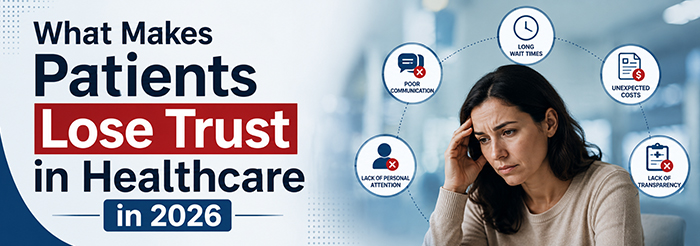
Patient trust in healthcare is fragile and critically important. Trust in doctors and hospitals fell from 71.5% in April 2020 to just 40.1% by January 2024. The trust crisis hasn’t ended in 2026. Patient mistrust is fueled by misinformation generated by artificial intelligence, insurance opacity, a doctor shortage, and an increasingly polarized information environment. Declining patient trust in the healthcare system poses great challenges.
For independent and group medical practices, this is a matter of business survival. Patients who don’t trust their doctors are postponing treatment, canceling treatment plans, leaving clinics, and warning others online. Let’s figure out what makes patients lose trust in healthcare!
The Healthcare Trust Crisis of 2026
The numbers are stark. Trust in one’s own doctor to make the right recommendations declined from 93% in 2023 to 85% in early 2025. It marks a drop in what was previously the most trusted relationship in healthcare.
The erosion is even more severe. 68% of Americans believe provider organizations put their own interests ahead of their patients’. By 2025, the Edelman Trust Barometer found that in 9 of 11 countries surveyed, a majority of people said healthcare institutions were actively undermining access to care.
Patients distinguish sharply between the system and their individual provider. Most people still trust their personal physician. The crisis is structural. That creates a meaningful window of opportunity for practices that communicate and behave accordingly.

Why Do Patients Distrust Doctors in 2026? 10 Core Reasons
1. Insurance Denials and the Profit-Over-Patient Perception
When patients are denied coverage, have their treatment delayed, or are bogged down in paperwork requiring pre-approval, they blame more than just their insurance company. They often lose trust in the entire system, including their doctor. The initial claim denial rate increased by 13 percentage points between 2021 and 2025. In 2025 alone, hospitals spent nearly $18 billion reversing denial decisions. Medicare Advantage insurers using artificial intelligence tools doubled the denial rate for older patients. Approximately 75% of these denials were overturned on appeal. However, less than 1% of patients ever filed an appeal. AMF Media Group and MGMA surveyed 2,400 US adults and found that the main drivers of eroded trust were insurance companies, pharmaceutical companies, and the government, not COVID-19 or the doctors themselves.
2. The Rise of AI Health Chatbots
One in three American adults now turns to AI-powered chatbots for health advice. This figure now rivals social media as a source of health information. Patients use AI because they want immediate answers, cannot afford treatment, or cannot get an appointment. About 1 in 5 adults who use AI for health cite inability to afford care or inability to get an appointment as a major reason. Patients who followed AI advice were five times more likely to experience health harm than those who did not. Leading AI language models often repeat false medical claims if they are phrased in clinical-sounding language.
3. Health Misinformation on Social Media
A peer-reviewed study published in Frontiers in Medicine found only 31% of patients reported high trust in the healthcare system. Patients with low trust were more likely to report that discussions about internet-found health information worsened their provider interaction. The more patients consume conflicting health content online — without a strong primary care relationship to filter it — the more difficult clinical encounters become.
4. Physician Shortage and Loss of Continuity
Trust is relational. When patients lose their regular physician, they lose the accumulated history and familiarity that makes clinical advice credible. 67% of federally qualified health centers lost between 5% and 25% of their workforce in a single six-month period during the pandemic, with many positions still unfilled today. Every appointment is a first appointment. And you must rebuild trust from zero, often in a 15-minute window.
5. Poor Communication and the Empathy Gap
Physician empathy determines patient trust. A study published in the journal Frontiers in Medicine found a significant positive correlation between physician empathy and trust, with patient satisfaction acting as a partial mediator. Rushing during appointments, loss of eye contact due to electronic medical record screens, and dismissive attitudes toward patient-reported symptoms erode trust. This is especially true for women, the elderly, and patients from marginalized communities.

6. Politicization and Government Distrust
Why do patients distrust doctors in 2026? The COVID-19 pandemic altered how a significant portion of the population relates to institutional health guidance. Public health measures became culture war flashpoints, and by association, physicians absorbed some of the resulting suspicion. KFF’s 2026 Health Information and Trust data found most Americans now distrust pharmaceutical companies, food and agriculture industries, and government health agencies to act in the public’s best interest.
7. Racial and Socioeconomic Inequities
Mistrust in healthcare is unevenly distributed. For Black, Latino, Indigenous, and low-income patients, the erosion of trust in healthcare institutions is compounded by preexisting mistrust of medicine, rooted in documented disparities in the quality of care and historical injustices. AJMC data showed that people with the lowest incomes are half as likely to have a personal physician as those with the highest incomes. It effectively deprives them of the fundamental relationships upon which trust is built.
8. AI in Clinical Decision-Making Without Disclosure
Nearly 66% of Americans had low trust in their health system to use AI responsibly. and nearly 58% doubted their provider would protect them from AI-caused harm. Most patients in nationally representative surveys said they want to know when AI is used in their diagnosis or treatment. Yet there is currently no federal law requiring providers to disclose this. When patients are not informed about AI’s role in their care and feel their data is being processed opaquely, it triggers a deep and rational sense of vulnerability.
9. Weak Online Reputation and Digital Absence
Trust is formed before the first appointment. 72% of patients consult online reviews before selecting a healthcare provider.
Patients prioritize online reviews over personal referrals, with 61% favoring reviews over recommendations from friends and family. A practice without a proactively managed digital presence is invisible to the majority of prospective patients.

10. Patient Safety Perceptions
Patients who rate their perception of safety as “top-box” give the practice a score of 85.3 on Likelihood to Recommend. It is compared to a drop of more than 50 points for any lower safety rating. When patients cannot visibly observe teamwork, coordination, and careful communication, they conclude they may not be safe. And a patient who does not feel safe is not a trusting patient.
Patient Trust in Healthcare 2026: The 10 Trust-Eroding Factors
A summary of the primary drivers of declining patient trust in 2026, with supporting data.
| # | Trust Driver | Key 2026 Data Point |
|---|---|---|
| 1 | Insurance Denials & Opacity | Claim rejection rates rose by 13 points; 68% believe providers put profits first. |
| 2 | Health Misinformation (Social/AI) | Only 31% of patients report high trust in the healthcare system (HINTS 7-2024 national data). |
| 3 | AI Without Transparency | 66% of Americans have low trust in their health system to use AI responsibly. |
| 4 | Physician Shortage / Loss of Continuity | 67% of FQHCs lost 5–25% of their workforce in a single six-month period during the pandemic. |
| 5 | Politicization of Healthcare | Edelman 2025: No institution—government, business, or NGO—is trusted to address health needs. |
| 6 | Perceived Profit-Over-Patient Motive | In 9 of 11 Edelman countries, a majority says institutions actively undermine access to care. |
| 7 | Poor Communication & Empathy Deficit | Patient satisfaction partially mediates the relationship between physician empathy and patient trust (Frontiers in Medicine, 2025). |
| 8 | Racial & Socioeconomic Disparities | Lower-income groups are 50% less likely to have a personal doctor compared with the highest-income group (AJMC). |
| 9 | Weak Digital Reputation | 87% of patients read reviews before choosing a provider, and 72% require a rating of four stars or higher (Birdeye 2025). |
| 10 | Patient Safety Perceptions | A safety-rated “top box” produces an LTR score of 85.3; anything less drops the score to 34.6 (Press Ganey 2025). |
Sources: MIEC (2026), KFF (2026), MGMA/AMF (2025), Edelman Trust Barometer (2025), Press Ganey (2025), Birdeye (2025), Frontiers in Medicine (2025), AJMC, STAT News (2026)
The Real-World Consequences of Declining Trust
The stakes extend well beyond patient satisfaction scores. STAT News reports that patients who distrust their healthcare providers are more likely to delay preventive screenings and discontinue medications. These patterns are linked to higher rates of hospitalization and premature death. For practices, distrust translates into patient attrition, reduced appointment compliance, and exposure to negative online reviews that compound the problem for prospective patients.
The good news is that trust can be rebuilt. Individual practices are well-positioned to rebuild trust. The trust crisis is directed primarily at the system, rather than at the individual provider. Practices that take deliberate, visible action to differentiate themselves from the structural failures of insurance, pharmaceutical influence, and government messaging strengthen the personal physician-patient bond that remains the most trusted relationship in healthcare.

How Practices Can Rebuild and Protect Patient Trust in 2026
Proactively communicate about insurance and AI. Concise and honest explanations protect the doctor-patient relationship from systemic problems.
Staff training, appointment pacing, and clear, empathetic communication signal trust. Rushing through the appointment is one of the most frequently cited reasons for mistrust.
Manage your digital reputation. Automate post-visit review requests, respond to all reviews within 48 hours, and ensure your Google Business Profile is accurate and active.
Ensure continuity of care. In an era of physician shortages and constant physician turnover in corporate healthcare, a clinic where patients consistently see the same specialist has a real advantage.
Bilingual staff, translated materials, and diverse physician teams directly reduce the trust gap between racial and cultural groups and expand your patient base.
If you use AI tools for diagnosis, scheduling, or documentation, inform your patients. Transparency in this area builds trust.
Conclusion
Clinical competence is a basic requirement. What retains patients, generates referrals, and withstands economic and competitive pressures? It’s patient trust in their physician. Patients who trust their doctors adhere to treatment plans, return for preventive care, and recommend their physician to others.
Since 1979, Practice Builders has supported the development of nearly 16,000 healthcare institutions. Our healthcare marketing services include reputation management, patient communication strategies, and digital presence optimization. We are ready to help healthcare institutions build the kind of trust that modern patients seek. Visit practicebuilders.com to learn more.
 Why Brand Authority Is the New Growth Strategy for..
 Why Topical Authority Is Essential for AI Search S..
 What Makes Patients Lose Trust in Healthcare in 20..