
Why Topical Authority Is Essential for AI Search Success
Posted on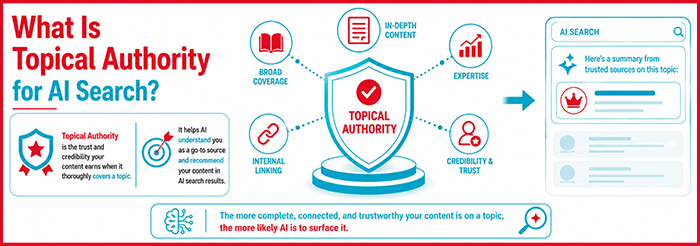
Topical authority helps AI search systems recognize your website as a dependable source for a defined subject. It does not come from page volume alone. It comes from clear expertise, complete topic coverage, useful internal connections, original proof, and consistent brand signals. Without that foundation, AI may retrieve your page yet choose another source for its answer or citation.
What Is Topical Authority for AI Search?
Topical authority describes the trust and expertise a website earns across one focused subject. Each page supports the same clear area of expertise while it avoids unrelated traffic goals.
Traditional SEO often treated one keyword and one page as the main unit of work. AI search uses a wider context. Google explains that its AI search features can create several related searches through query fan out, then retrieve useful pages from its search index. That process rewards sites that cover connected needs with depth and clarity.
A pillar page defines the central subject. Cluster pages answer narrower questions. Contextual internal links show how those answers relate. Together, they create a clear path for people and search systems.
What Determines Topical Authority for AI Search?
Content breadth matters, but page count does not prove authority. A focused library needs several qualities:

- Complete coverage of the questions that matter to the audience
- Accurate answers with clear dates, sources, and expert review
- Firsthand insight, such as case data, original examples, or specialist commentary
- Logical internal links between related pages
- Consistent authors, services, credentials, and brand descriptions
- Relevant mentions from credible sites, videos, directories, and professional communities
- Strong technical access for search crawlers
The benefits of topical authority in SEO content planning start with better priorities. Rather than choose isolated articles from a keyword list, teams can map a subject, find gaps, protect pages from overlap, and direct each page toward a distinct user need.
Semantic SEO and topical authority also work together. Semantic SEO clarifies the people, services, conditions, tools, and ideas within a subject. Topical authority proves that the brand can explain those relationships with accuracy and useful depth.
Why AI Search Prioritizes Topical Authority
AI search does not simply select the page with the most repeated keywords. It retrieves sources, compares relevance, and creates a combined answer. A 2026 controlled study ran 252,000 trials across six language models. The researchers found that topical relevance and source position had the largest effect on which source earned the first citation.
A separate 2026 study of Google AI Overviews found that nearly 30% of cited domains did not appear among the first page results Google showed for the same queries. A classic page one rank may help, but it does not guarantee selection inside an AI answer.
A brand can hold strong search positions yet lose the citation when another source gives a clearer, more relevant answer. A smaller specialist can also earn visibility when its content matches the exact topic and supports the answer with stronger evidence.

Building topical authority for AI models therefore requires more than publication volume. It requires a clear relationship between the brand, the topic, the audience, and the proof behind each claim.
Steps to Build Topical Authority for AI Search
The key steps to build topical authority for content start with focus, not output.
1. Define Your Topical Authority and Differentiation
Choose the subject where your brand can offer real value. Define the audience, the problems you solve, the services or products tied to the topic, and the proof that separates you from broad publishers.
For a healthcare practice, “orthopedics” may feel too wide. “Nonsurgical knee pain care for active adults” gives the team a clearer content boundary and a stronger basis for useful examples.
2. Evaluate How AI Search Understands Your Topical Authority
Ask major AI search tools the questions your prospects ask. Note which brands appear, which sources receive citations, and how each system describes your company. Test several prompt forms because results can vary by prompt and platform.
Does the About page state your specialty clearly? Do service pages use the same terms as professional profiles? Do author pages confirm expertise?

3. Optimize Content for Topical Authority
Audit current pages before you commission new ones. Merge duplicate articles. Update old claims. Improve weak introductions with direct answers. Add useful examples, expert review details, descriptive links, and clear next steps.
Build a content map around one pillar page and its related questions. Each cluster page should answer a distinct need and link to the next logical question. This creates a practical SEO topical authority strategy rather than a loose archive of posts.
4. Publish Expert Content That Builds Topical Authority
Generic summaries add little value because AI systems can produce similar text at almost no cost. Publish material that reflects your real access and experience.
Use original surveys, case examples, expert interviews, process explanations, decision criteria, comparison tables, and lessons from actual client work. Google advises site owners to create useful material with a unique point of view instead of content that merely repeats common information.
5. Strengthen Entity Signals for Topical Authority
Keep the brand name, specialty, leadership details, service descriptions, and contact information consistent across the website and credible external profiles. Add accurate Organization, Person, Article, and Breadcrumb schema where each type fits the visible page.

Earn relevant third-party mentions through expert contributions, podcasts, research partnerships, professional associations, and strong public resources. Do not buy empty mentions. Google states that inauthentic mentions do not offer a sound path to AI visibility.
At Practice Builders, we view topical authority as a trust system, not a blog quota. A healthcare brand should connect expert knowledge, patient questions, service pages, local relevance, technical clarity, and outside credibility. That unified structure helps people find the right answer and gives AI search systems a clearer reason to cite the source.
Topical Authority Mistakes That Limit AI Visibility
- Publish one page for every keyword variation
- Enter topics that have no clear link to the brand
- Create several pages that answer the same question
- Use broad claims without proof or expert review
- Leave old dates, statistics, and service details on live pages
- Hide expertise behind generic author names
- Add internal links without a clear user purpose
- Treat a schema as a shortcut instead of a description of visible content
- Track search rank alone and ignore AI citations, brand mentions, and assisted conversions
These mistakes create noise, reduce trust, and waste content resources.
Topical Authority Conclusion for AI Search Success
Topical authority gives search systems a clear answer to three questions: What does this brand know? Why should anyone trust it, and when should an AI system cite it?
The brands that act now can replace scattered content with a focused authority system. Review your topic coverage, remove weak duplication, add real proof, connect related pages, and measure citations across AI search tools. Practice Builders can help healthcare organizations build an SEO and AI visibility plan that turns expertise into discoverability, trust, and qualified demand.
 Why Brand Authority Is the New Growth Strategy for..
 Why Topical Authority Is Essential for AI Search S..
 What Makes Patients Lose Trust in Healthcare in 20..